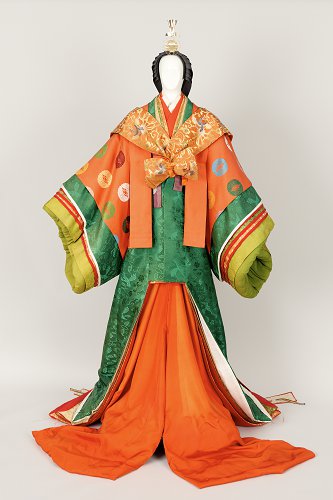
The costume on display here is a jūnihitoe (literally, “twelve layers”), a formal, elaborately crafted traditional garment whose origins date back to the Heian period (794–1185/1192). During that period, it was worn by noblewomen at the imperial court during ceremonies or other special occasions. Today, the jūnihitoe can still be seen at the enthronement ceremony of the Japanese imperial couple and at the wedding ceremonies of imperial princesses.
However, Japanese people are most familiar with the jūnihitoe through the dolls that are displayed annually for the Girls’ Festival
(hina-matsuri) on the 3rd day of the 3rd month in families with daughters, typically arranged on a multi-tiered doll display stand. This is because some of the female dolls – most notably the Empress seated next to the Emperor and other high-ranking ladies of the court – are dressed in these
jūnihitoe robes modeled after those of the Heian period.
The jūnihitoe consists of numerous garments or layers of fabric, but the literal translation of the term as “twelve layers” is misleading, since jūni (“twelve”) has to be understood here in the sense of “many.” We know from Heian-period accounts that sometimes even more than 20 layers were worn on top of one another. The number varied depending on current fashion trends, the lady’s social rank, the occasion, and so on. However, too many layers significantly restricted freedom of movement, even though the silk fabrics were generally thinner than in later periods.
Originally, the layers served to protect against the winter cold, but another aspect soon came into play among the court nobility: By skillfully combining the various parts of the jūnihitoe jūnihitoe – its color scheme and patterns – the wearer demonstrated not only her good taste, elegance, and sophistication, but also her refinement and noble character. Court ladies therefore liked to let the hem of their sleeves – where the various layers were clearly visible – peek out promisingly from their carriages during outings.
Colors and patterns held significance in all cultures. In Heian-period Japan, colors could signify a specific court rank or hierarchical status (similar to purple in the West); some could only be worn with imperial permission. Often, color names or motifs referred to nature and the seasons, conveyed corresponding moods and messages, and evoked the desired associations in the literate observer. Much of this, however, is no longer familiar even to Japanese people today.
During the Heian period, the dyeing techniques of the time largely allowed only solid-colored fabrics with simple patterns. Since many of the layers of clothing were visible only at the sleeves, the lower hem, or the collar, the primary focus was on the appropriate combination of the various layers of color (jap. kasane no irome). Only a few of the layers – primarily the outer garments such as the
uwagi overrobe, karaginu jacket and mo skirt – were more elaborately decorated, for example, embroidered with other colors or woven with contrasting threads.
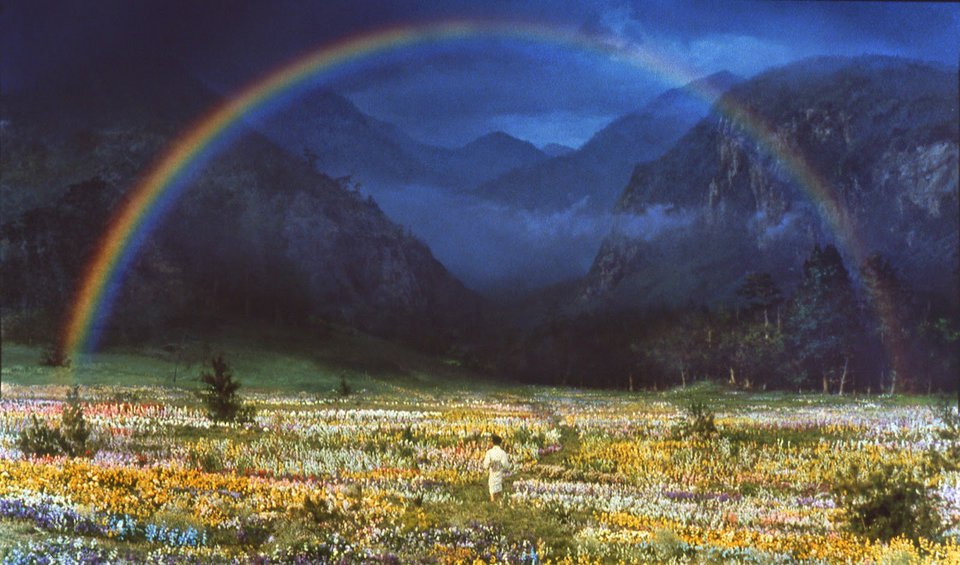
Kurosawa was known for his thoughtful use of color and deliberately matched the color palette of the costumes in the film “Dreams” to each respective episode. “The Peach Blossom Garden” refers to the fact that the Girls’ Festival is also known as momo no sekku (“Peach Festival”), since the peach trees used to be in bloom at the time this festival was celebrated – on the 3rd day of the 3rd month according to the old lunar calendar. Peaches were also believed to have the power to ward off evil. To this day, families associate the celebration of the “Peach Festival” with the wish that nothing bad will happen to their daughters and that they will find happiness in their lives. The puppets, which come to life, are dancing and playing music to the ceremonial Gagaku music and represent – with their colorful robes – the lost beauty and vitality of the tree spirits of the cleared peach grove. They are an expression of the little boy’s vivid memories of their former splendor in bloom.
Components of the jūnihitoe (十二単) on display here:
- 1 – kosode (小袖) – a single-layered, plain undergarment.
- 2 – naga-bakama (長袴) or hari-bakama (張袴) – long trousers with extra-long legs.
Scarlet trousers were very popular among high-ranking women during the Heian period; today, we still see them (with shorter legs), for example, worn by Shinto shrine maidens (miko). Vibrant shades of red, such as this yellow-red
(beni-hi) dyed with safflower (benibana), typically signify young, unmarried women, including in traditional Nō theater.
- 3 – hitoe (単衣) – a single-layered, unlined garment. Shown here in a willow-green (yanagi) shade with a red silk crepe collar. Traditional patterns such as floral diamonds (hanabishi) are woven into the fabric: these “courtly patterns” (yūsoku monyō), which originally reached Japan via China from countries such as India and Persia, were once reserved for the nobility. The sleeves contain padded silk crepe inserts in a green reminiscent of young spring grass (wakakusa) to protect against the cold.
- 4 – itsutsuginu (五衣) – a so-called “five-layer” robe consisting of several individual garments (uchigi, 袿) worn one on top of the other (there do not necessarily always have to be five). Here, there are three layers of woven and patterned silk brocade, each separated by a red stripe (possibly the folded lining). The colors and symbols have various meanings:
- Layer 1 in peach-orange: The bold orange is brightened by the woven-in gold and white motifs, possibly fish and waterfowl.
- Layer 2 in spring-like green (moegi): woven autumn flowers (bush clover, bellflowers, chrysanthemums), a hexagonal pattern representing a turtle shell (kikkō) that symbolizes long life, as well as elegant, courtly floral diamonds (hanabishi)
- Layer 3 in yellow (ki; possibly “corn yellow” tōmorokoshi, dyed with peach tree bark, among other things): woven flower-bird circles (hana-tori-maru) and camellias that ward off evil forces (tsubaki)
-
5 – Robe (uchiginu 打衣 打衣 “beaten robe”) worn over the itsutsuginu, which can add a colorful accent: It owes its name to the way it is worked with a hammer during production to create a glossy finish—shown here in a purple-lilac color permitted only to high-ranking individuals, though it is barely visible beneath the robes worn over it.
-
6 – uwagi 表着, “outer kimono”: Here in dark blue-green with a timeless woven pattern featuring auspicious phoenixes (hōō), vines (karakusa) symbolizing lasting bonds, and flowers.
-
7 – karaginu 唐衣 (literally “Chinese robe,” as it is modeled after the clothing of China’s Tang Dynasty): a short jacket that covers only the upper body, usually very ornately designed, with narrower shoulders. Here made of orange-red silk, reminiscent of the color cinnabar red (ōni or ōtan), reserved for the crown prince; woven in the popular combination of hexagons and circular motifs: The hexagons represent the tortoise shell (kikkō), which promises long life; the circles, embodying infinity, abundance, and harmony, feature butterflies (mukai-ageha-chō) embroidered in various colors, facing each other with outstretched wings, which can symbolize, among other things, immortality, metamorphosis, joy, and success.
-
8 – Wrap skirt (mo 裳), which is tied above the hips over all previous layers of. Shown here in off-white with a woven checkerboard pattern (ichimatsu) and classic, elegant Shōsōin decoration on the wide back waistband. The flowing skirt features floral diamonds woven in the Takeda-bishi style, over which is painted a motif once reserved for the Japanese imperial family: blue-bell paulownia trees (kiri) and flying phoenixes, which – according to legend – live in the paulownia tree as particularly noble creatures.
The white hip sashes (hikigoshi) that cascade down the back, adorned with narrow cords in the “Five Colors” (goshiki)—green/blue, yellow, red, white, and black—based on the Chinese Yin-Yang philosophy, enhance the overall decorative effect.
The overall look is complemented by the ōsuberakashi (大垂髪) hairstyle, which was customary at court during the Heian period and is only hinted at here: hair falling far down the back, gathered at one or more points with a strip of paper or a colored hair ribbon (絵元結) (e-mottoi / e-motoyui). Here, it is a simple white strip of paper.
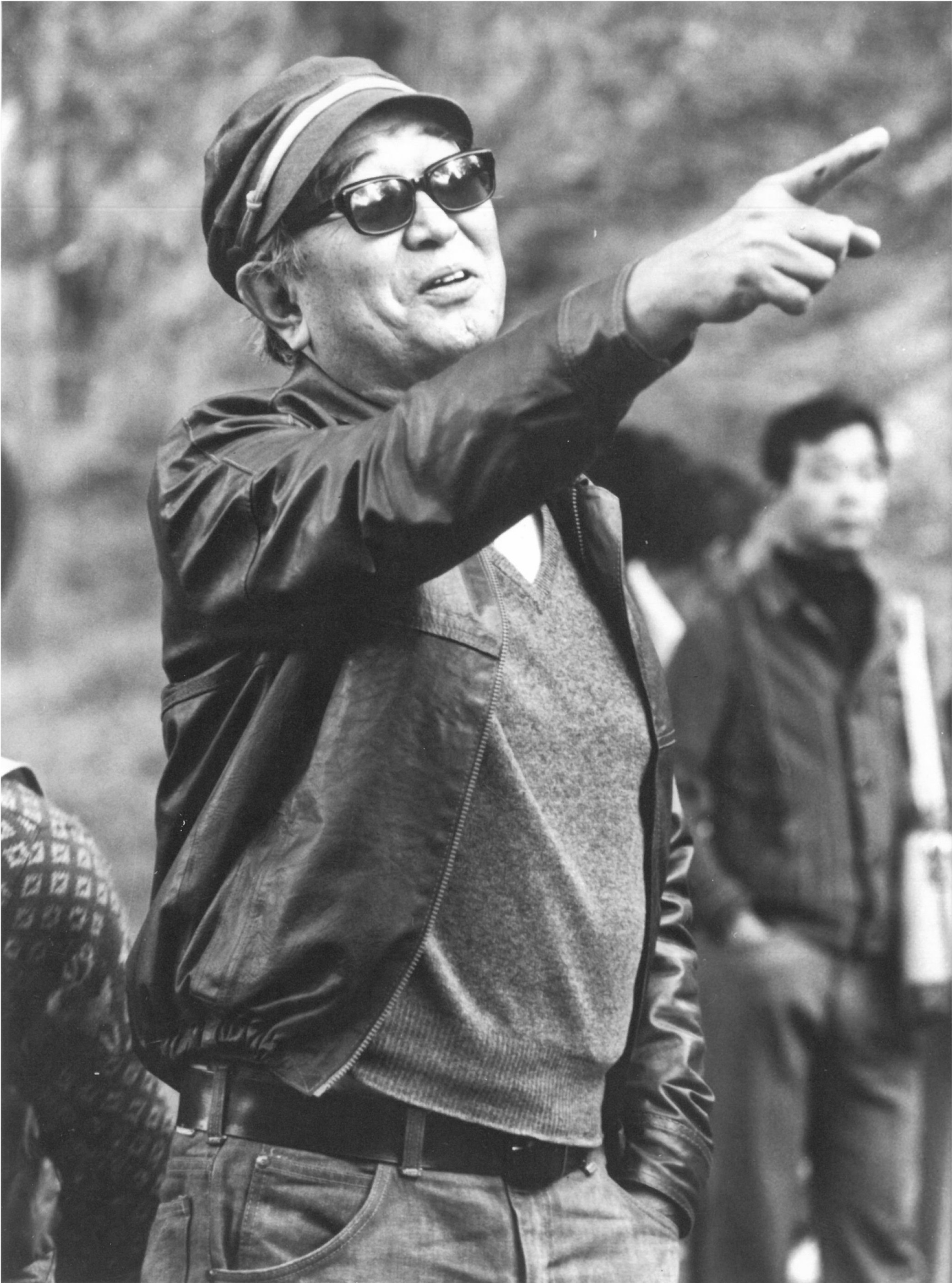
Kurosawa, who always strove for attention to detail, drew on traditional motifs for the decoration of the jūnihitoe fabrics and was inspired by Heian-period color schemes when selecting the colors for this costume. At the same time, he captured the orange, red, and yellow of the peach fruit (not the pink peach blossoms!) as well as various shades of green from the contrasting leaves and grasses in nature as it awakens in spring. The bold hues largely correspond to those of earlier centuries; however, lighting conditions indoors were different back then, so the colors usually appeared more subdued. The silk fabrics dyed with plant-based dyes also changed over time. Yet the striking color contrasts between the complementary colors of orange-red and green, and the splendor of the costume, certainly continue to make an impression on viewers to this day.
 Summary
 Biography of
 Biography of
 Detailed Information about the costume